1940s Women Attire Retro Fashion Guide
- 1.
ever tried cycling in a skirt while carrying a gas mask and still looking like Marlene Dietrich’s cooler cousin?
- 2.
utility clothing: when the government designed your wardrobe (and somehow got it right)
- 3.
padded shoulders: because confidence starts at the collarbone
- 4.
skirts, slacks, and the quiet rise of the trouser rebellion
- 5.
the art of the make-do: when your wardrobe became a wartime project
- 6.
lipstick as armour: why red was never *just* a colour
- 7.
footwear: clompy, clever, and weirdly covetable today
- 8.
hairstyles: engineering elegance, one pin at a time
- 9.
evening glamour: when blackout curtains became ballgowns
- 10.
how to spot—and wear—1940s women attire like a proper period pro
Table of Contents
1940s women attire
ever tried cycling in a skirt while carrying a gas mask and still looking like Marlene Dietrich’s cooler cousin?
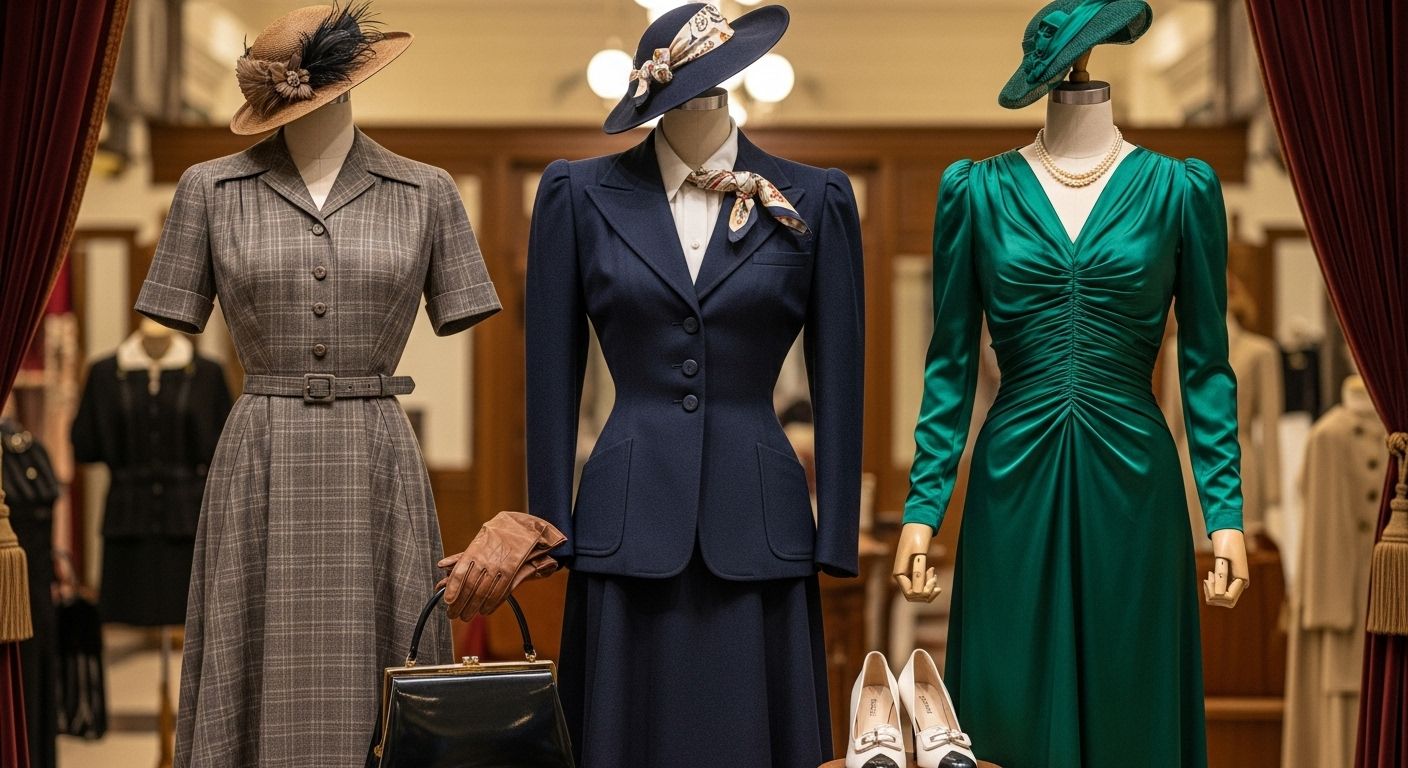
If you’ve ever rummaged through a charity shop, found a boxy jacket with shoulder pads like a rugby prop’s, and thought—*“Blimey, this could double as body armour”*—then congratulations, you’ve stumbled upon the spirit of 1940s women attire. We didn’t just *dress* back then; we *strategised*. Every stitch was a statement, every hem a compromise between regulation and rebellion. The 1940s women attire wasn’t about vanity—it was *vitality* disguised as velvet, duty draped in tweed, and defiance dipped in Victory Red lipstick. And let’s be honest: nothing says “I’ve survived the Blitz” quite like a perfectly rolled turban and eyeliner sharp enough to cut bureaucracy.
utility clothing: when the government designed your wardrobe (and somehow got it right)
In 1941, the Board of Trade dropped **CC41**—the little label that whispered, *“This frock meets His Majesty’s standards for austerity and elegance.”* No more than 2.5 yards of fabric. Max three buttons. Skirt length? Knee-grazing (21 inches from waist—*no arguments*). Yet somehow, designers like Hardy Amies and Digby Morton turned restriction into *revolution*. The 1940s women attire utility dress was a masterpiece of minimalism: clean lines, natural waist, side pockets (*yes, pockets!*), and just enough flare to swing-dance in. As one factory forewoman put it: “If it fits, it fights.” And sister, we fought—on the line, on the bus, and on the dancefloor after shift.
padded shoulders: because confidence starts at the collarbone
Those shoulders weren’t *broad*—they were *architectural*. Inspired by military tailoring and Hollywood heroines, the 1940s women attire silhouette screamed *authority*—even if your job was queuing for spam or re-inking ration books. Shoulder pads weren’t optional; they were *emotional support*. Made from felt, kapok, or—true story—rolled-up newspaper in a pinch, they gave you the stance of a woman who *knew* where the shelter was *and* who’d brought the biscuits. As *Vogue* declared in ’42: “A strong shoulder is the new strong chin.” And let’s be real: when your world’s falling apart, a good set of shoulders *helps*.
skirts, slacks, and the quiet rise of the trouser rebellion
“Did women in the 1940s wear pants?” Oh, absolutely*—and not just in the factory. By 1942, slacks were officially *civilian-approved* for “active duties” (cycling, gardening, dodging doodlebugs). Wide-legged, high-waisted, and often in sturdy corduroy or denim, they paired with belted tunics or crisp blouses—and *still* came with a warning label: *“For practical wear only. Not for evening or church.”* But we wore them everywhere. Land Girls in jodhpurs, Wrens in navy-blue overalls, even debutantes sneaking trousers to the Palais under their coats. The 1940s women attire trouser wasn’t fashion—it was *freedom*, hemmed to just below the ankle and laced with quiet mutiny.
the art of the make-do: when your wardrobe became a wartime project
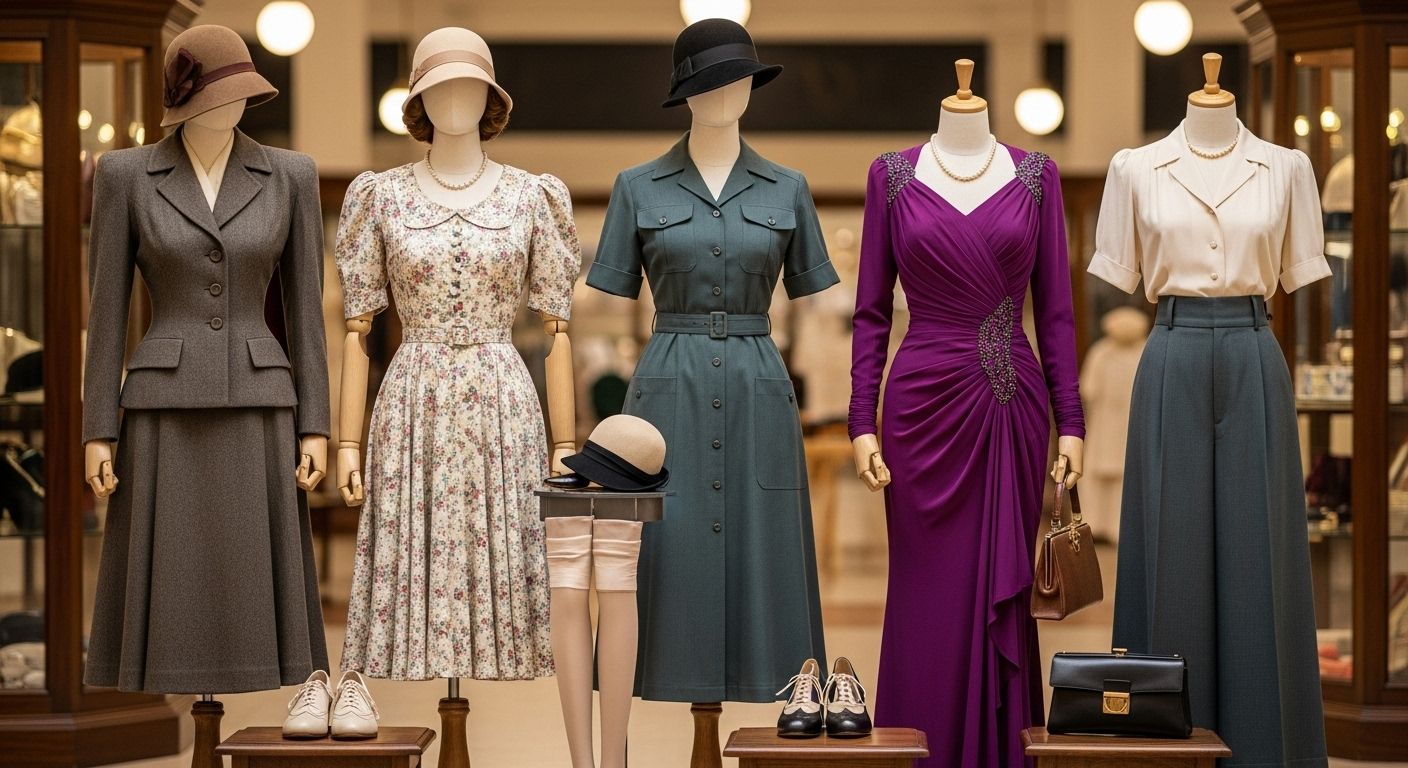
“Make Do and Mend” wasn’t a slogan—it was a *national curriculum*. Got a tear? Embroider over it. Skirt too long? Hem it, then use the offcut for a hairband. Stockings run? Draw a seam up the back with eyebrow pencil (Max Factor’s *Liquid Stocking* sold out by lunchtime). Below, the real MVPs of 1940s women attire resourcefulness:
lipstick as armour: why red was never *just* a colour
Here’s a wartime truth: the government *refused* to ration lipstick. Why? Because morale wasn’t measured in calories—it was measured in *colour*. “Victory Red”, “Regimental Red”, “Montezuma Red”—each shade a tiny act of resistance. Women applied it *over* gas masks, *after* air raids, even *in* bomb shelters. As Helena Rubinstein famously said: “There are no ugly women—only lazy ones. And in wartime, *laziness is treason*.” The 1940s women attire beauty kit was lean: red lips, pencilled brows, a dusting of powder (to hide the pallor), and *one* beauty mark—drawn just so. Not vanity. *Vigilance*.
footwear: clompy, clever, and weirdly covetable today
Leather? Reserved for pilots and boots. So we got *creative*: cork wedge soles (lightweight, quiet on stairs), open-toe “spectator” pumps (two-tone—smart *and* scuff-hiding), and the legendary **Wren’s shoe**—low-heeled, lace-up, rubber-soled. No heels over 2 inches—not just regulation, but *common sense* (cobblestones don’t forgive stilettos). And let’s not forget the **ATS boot**: ankle-height, brown, single strap—stolen from surplus shops faster than a cuppa vanished at roll call. The 1940s women attire footwear rule? *If it won’t let you run to the shelter, cycle to work, and still tap-dance at the hop—it’s not worth lacing up.*
hairstyles: engineering elegance, one pin at a time
Long hair + machinery = disaster. So we *built* our hair. Victory Rolls? Two barrel curls, pinned high—inspired by RAF fighter spins. Snoods? Knitted or netted pouches that held hair *securely*—but looked like you’d just stepped out of *Casablanca*. Turbans? Not costume—they covered rollers, hid greasy roots, and added *three inches of psychological advantage*. Hair wasn’t *styled*—it was *fortified*. As one NAAFI waitress put it: “If me curls can survive a double shift and a near-miss, they can survive your criticism.” Now *that’s* the 1940s women attire mindset.
evening glamour: when blackout curtains became ballgowns
Don’t let the rationing fool you—when the sun went down, *darlings*, we *sparkled*. Evening 1940s women attire leaned into Hollywood: bias-cut rayon (if you could scrounge it), faux-fur stoles (rabbit, dyed to look like mink), and gloves—*always* gloves (elbow for opera, wrist for the local Palais). Necklines dipped, backs plunged—but modesty panels kept things *just* respectable. Accessories? Bakelite bangles, rhinestone brooches, and *one* statement earring if you’d lost its twin in an air raid. As *Harper’s Bazaar* wrote in ’44: “Elegance is not what you wear—it’s how you wear your hope.”
how to spot—and wear—1940s women attire like a proper period pro
Fancy channelling the era without time-travelling? Here’s our no-nonsense, no-fainting checklist for nailing 1940s women attire in 2025:
- Silhouette: Natural waist, *cinched*. Shoulders? *Padded*. Skirt? Knee-length, A-line or panelled.
- Fabric: Wool, rayon, or cotton—*never* clingy synthetics. Look for subtle textures: herringbone, faille, barkcloth prints.
- Details: Patch pockets, self-fabric belts, button-front blouses. No zips at the side—*only* back or side-seam.
- CC41 clue: Utility garments had a *boxed CC41 mark* on the label—like a tiny badge of honour.
- Attitude: Stand tall. Smile like you’ve just heard the war’s *nearly* over.
And if you’re after deeper cuts—like how to date a dress by its hem tape, or why seamed stockings are back with a vengeance—pop over to The Great War Archive, lose yourself in our History vault, or compare styles with our definitive guide: 1940s women clothes iconic wardrobe.
Frequently Asked Questions
How to tell if a dress is 1940s?
Look for four giveaways: 1) **Natural waistline**, sharply defined; 2) **Padded shoulders** (even in lightweight fabrics); 3) **Knee-length skirt**, often with subtle flare or gores (not circle-cut); 4) **Side or back zip** (metal, *not* plastic—nylon zips didn’t arrive till ’48). Bonus points for a **CC41 label** (boxed, black-on-white) or wartime-era rayon with that *distinctive rustle*. The 1940s women attire aesthetic is clean, structured, and quietly defiant—never flouncy, never sloppy.
How to look like 1940s?
Start with *shape*, not costume: waist-cinched dress or suit, shoulder emphasis (even a blazer with subtle padding helps), and hair *up*—Victory Rolls, snood, or turban. Add seamed stockings (draw the line with liquid eyeliner if needed), red lips, and a brooch at the collar. The 1940s women attire look isn’t about replication—it’s about *resonance*. As one vintage dealer says: *“If you feel like you could mend a radio, dance a jitterbug, and still look fabulous—you’re there.”
What was a trend in the 1940s?
Beyond padded shoulders and red lips? **The shirtwaist dress**—button-front, belted, with puffed or cap sleeves—was the workhorse of the decade. **Turbans** peaked during the war (practical *and* chic). **Polka dots** surged post-1945 (symbolising joy returning). And let’s not forget **patch pockets**—functional, flattering, and *everywhere*. But the biggest trend? **Confidence disguised as conformity**. The 1940s women attire era proved you could follow the rules *and* rewrite them—stitch by stitch.
Did women in the 1940s wear pants?
Absolutely—and not just in factories. By 1942, slacks were widely accepted for cycling, gardening, and “active leisure.” Land Girls wore jodhpurs; Wrens and ATS women had regulation trousers; and fashion magazines *endorsed* “smart slacks” for country weekends. Yes, some clubs still barred trouser-wearers—but by 1947, even *Debrett’s* conceded: *“In the right cut and context, slacks are no longer revolutionary—merely reasonable.” The 1940s women attire trouser was the quiet start of a sartorial revolution.
References
- https://www.vam.ac.uk/articles/utility-clothing-wwii
- https://www.iwm.org.uk/history/womens-fashion-in-world-war-two
- https://www.historyextra.com/period/second-world-war/1940s-fashion-women-clothes-ww2-make-do-mend
- https://www.metmuseum.org/toah/hd/wrld/hd_wrld.htm